


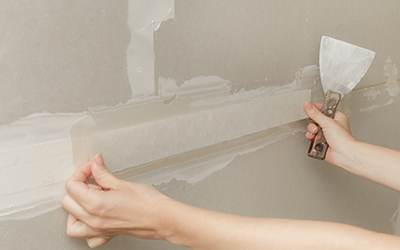
There is a saying in the trade: “Paint hides nothing; it highlights everything.”
You can hang drywall perfectly. You can screw it off with military precision. But if the drywall taping is even slightly off, the moment you roll a coat of semi-gloss paint on that wall and turn on the lights, every mistake will scream at you.
Blisters, ridges, visible seams, and “starved” joints—these aren’t just cosmetic annoyances. They are structural failures in the wall surface.
At Ontario Drywall & Taping, we spend a significant amount of time fixing DIY jobs or correcting work from “handymen” who treated taping like a simple plastering gig. Taping is an art form that relies on timing, pressure, and chemical bonding.
Here is a breakdown of the most common defects we see, why they happen, and how to ensure your walls end up with a smooth drywall finish.
1. The “Bubble” or Blister (Tape Lift)
This is the most common complaint we hear. You finish the wall, sand it, paint it, and suddenly a long, vertical bubble appears right down the center of the seam. If you press on it, it moves.
Why it happens: Blisters occur for one reason: a lack of adhesion. This happens because of two main errors:
- Dry Joint: There wasn’t enough compound (mud) underneath the paper tape to begin with. The tape was effectively applied to dry paper.
- Wiping Too Hard: When embedding the tape, the taper pressed the knife too firmly, squeezing all the mud out from behind the tape. Without that thin layer of mud acting as glue, the tape releases from the wall as it dries.
The Fix: You cannot paint over a blister. You have to cut the bubble out with a utility knife. If the section is small, you can inject some watered-down mud behind it and smooth it back down. If it’s a long run, you have to tear that section of tape off and re-tape it completely.
2. The “Hump” (Ridged Joints)
A proper drywall joint should be flat. However, because the tape adds thickness, the joint naturally wants to sit higher than the surrounding wall. A bad taping job leaves a visible vertical ridge that looks like a speed bump under the paint.
Why it happens: This is usually an issue with butt joints (where two non-tapered ends of drywall meet). Unlike the long edges of drywall sheets, which are tapered (indented) to accept tape, butt joints are flat. If you just tape over them and add mud, you create a hump.
The Fix: The secret is “feathering.” A butt joint needs to be built out wide—often 10 to 12 inches on either side of the center tape. By gradually sloping the compound outward, you trick the eye into seeing a flat wall. If you can feel the ridge with your hand, you will definitely see it with your eyes.
3. “Starved” Joints (Visible Tape)
A starved joint is one where the outline of the paper tape is clearly visible through the finished wall. It looks like someone just painted over a piece of masking tape.
Why it happens: This happens when the compound shrinks too much during drying, or not enough fill coats were applied. Standard all-purpose mud shrinks as it dries. If the taper applies one heavy coat and walks away, that mud will suck back into the joint, exposing the edges of the tape.
The Fix: This requires a proper three-coat system:
- Tape Coat: Embed the tape.
- Fill Coat: Fill the recess flush with the wall.
- Skim Coat: A tight, thin final layer to blend everything together. You cannot rush this. Each coat must dry before the next one is applied.
4. Cracking (The Hairline Fracture)
Cracks usually appear in corners or above door frames.
Why it happens:
- Structural Movement: The house is settling, or the drywall wasn’t screwed into the studs securely enough.
- Wrong Mud: Using a high-shrinkage drying mud for a deep fill (like a gap between sheets) usually leads to cracking.
- Mesh vs. Paper: Fiberglass mesh tape is popular for DIYers because it’s self-adhesive, but it is significantly weaker than paper tape. If used in corners or structural seams without “hot mud” (chemically setting compound), it will almost always crack eventually.
Troubleshooting Guide
|
Defect |
The Cause |
The Professional Solution |
|
Bubbles/Blisters |
Not enough mud behind tape. |
Cut out the bubble, re-mud, and re-tape. Don’t just paint over it. |
|
Edge Cracking |
Drywall sheets not secured. |
Add screws to the stud to stop movement, then re-tape. |
|
Rough Surface |
Improper sanding (“fuzzing”). |
Use fine-grit sandpaper (150-220) and sand in a circular motion. Do not sand down to the paper face. |
|
Pockmarks |
Air bubbles in the mud mix. |
“Work” the mud in the pan before applying to remove air pockets. Skim coat tightly. |
The Lighting Test: The Moment of Truth
The biggest mistake DIYers make is working in bad lighting. You might think the wall looks smooth at noon when the sun is overhead, but at 8:00 PM when the floor lamps are on, the shadows will reveal every flaw.
At Ontario Drywall & Taping, we use high-lumen work lights positioned at a sharp angle (raking light) along the wall during the sanding process. This highlights every ridge, scratch, and bubble so we can fix them before the primer ever touches the wall.
Why Professional Taping Is Important
Taping isn’t just about covering gaps; it’s about creating a monolithic surface. The goal is to make twenty different sheets of drywall look like one continuous, solid wall.
Achieving a true Level 4 or Level 5 smooth finish requires muscle memory. It requires knowing exactly how much pressure to apply to the trowel to wipe the joint clean without starving it. It requires knowing how the humidity in your house today will affect the drying time of the mud tomorrow.
When you hire a professional, you aren’t just paying for the mud; you are paying for the guarantee that when the paint dries, your walls will look perfect.
Is Your Drywall Ready for Paint?
If you are dealing with bubbled tape, uneven joints, or cracks that keep coming back, stop struggling with the spackle knife.
At Ontario Drywall & Taping, we specialize in high-quality taping services that deliver flawless results. Whether it’s a basement renovation or a whole-home finish, we have the tools and the expertise to make your walls look like they were cast in place.
Don’t let bad taping ruin your renovation. Contact us today to schedule a consultation or site visit. Call: (647) 878-4466 Email: info@ontariodrywallandtaping.ca

