


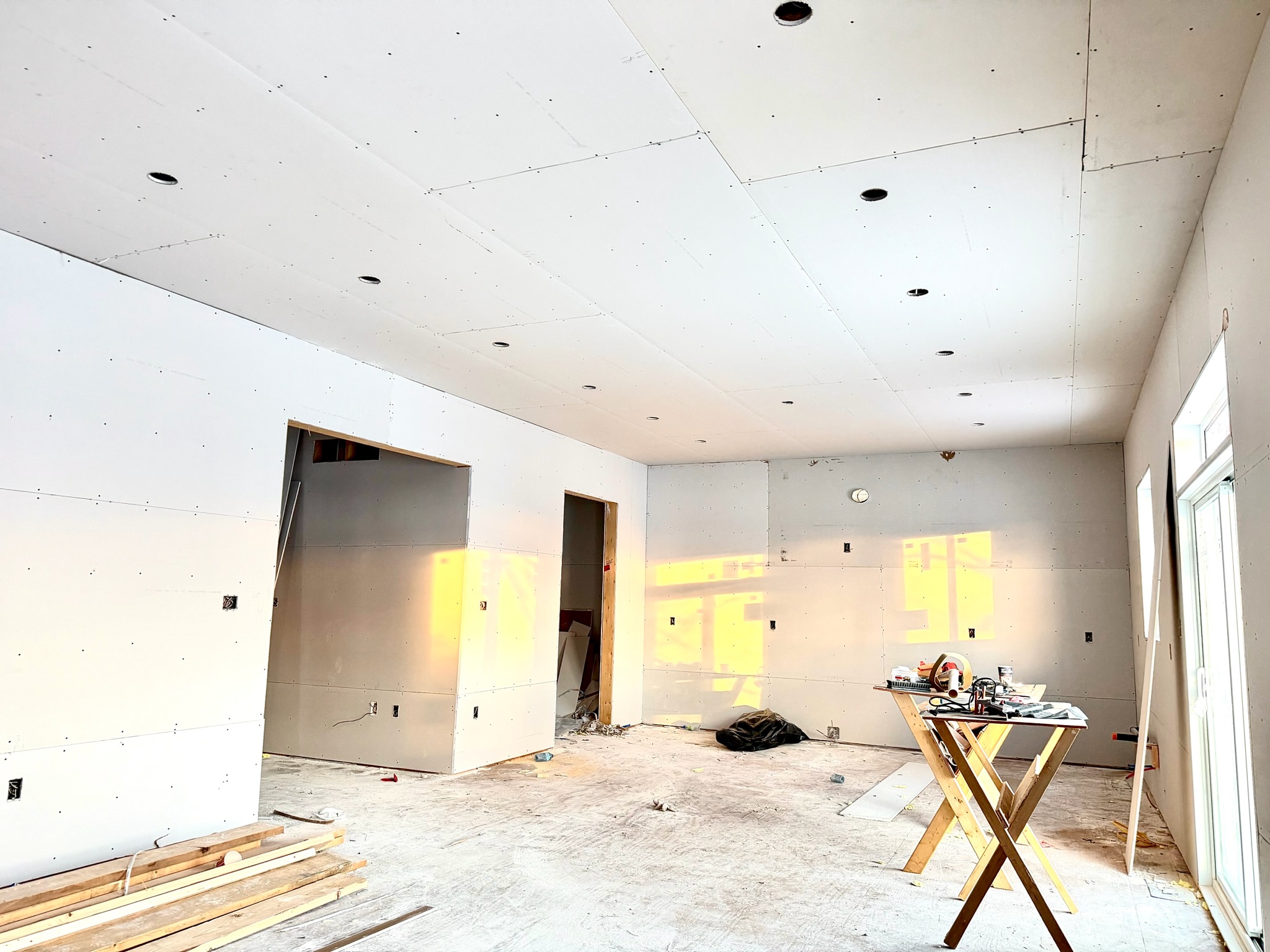
Every winter, the same thing happens on commercial jobs across the GTA. The building is closed in, the boards go up fast, and the taping crew is pushed to keep pace. Then spring comes, the walls get painted, and the deficiency list fills up with ridged joints, nail pops and seams you can see from across the room.
Most of those problems were built in back in January. Drywall compound doesn’t care about the schedule. It cares about temperature, humidity and time. Get those wrong and the work can look fine for weeks, then show up later as something you’re paying to fix.
We’ve been taping and finishing drywall in Ontario for more than 11 years. This is what we tell the general contractors and project managers we work with every time the temperature drops.
Why cold weather ruins a tape job
Joint compound is mostly water. A ready-mix (drying-type) compound only hardens when that water leaves. In a cold building the water leaves slowly, and in a cold, humid building it barely leaves at all.
That causes three kinds of trouble:
- Coats go on before the coat underneath is dry. The surface feels hard, so the next coat goes on. The compound underneath keeps shrinking for days, and the joint sinks or ridges after the walls are painted. Industry guidance calls this delayed shrinkage.
- The bond is weaker. Manufacturers such as CertainTeed list cold, damp conditions as a cause of bond failure, beading, nail popping, joint shadowing and sagging boards.
- Material freezes. Compound that freezes in storage can be thawed and used for some coats, but industry guidance is clear that previously frozen compound should never be used as a finish coat.
None of this shows up on the day. That’s what makes it expensive.
The numbers that matter
The main industry standard for drywall finishing is the Gypsum Association’s GA-216. The 2016 edition sets these minimums:
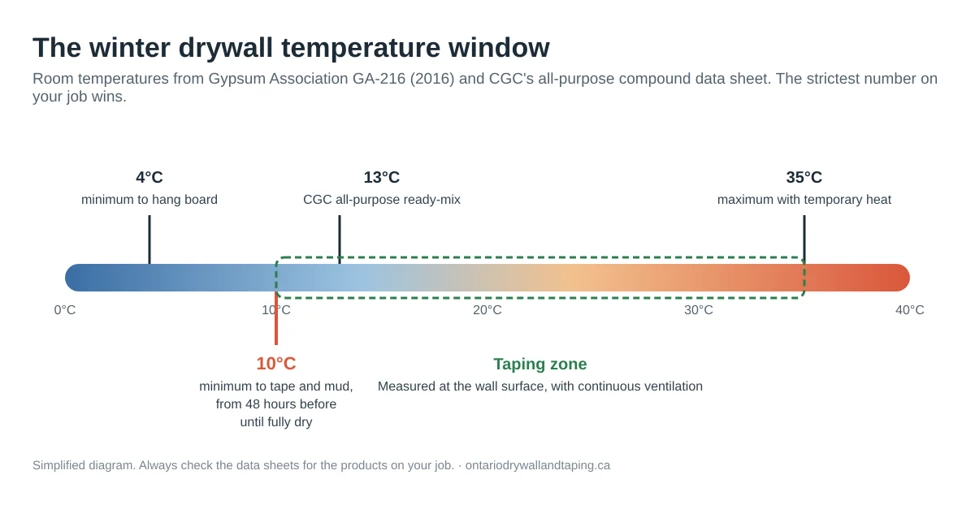
- Hanging the board (screws or nails): the room must be at least 4°C (40°F).
- Taping, mudding, texturing and adhesive: the room must be at least 10°C (50°F), starting at least 48 hours before the work begins and lasting until the compound is completely dry.
- Temporary heat: no room should go above 35°C (95°F), because compound that dries too fast can crack.
- Ventilation: there must be adequate, continuous ventilation while the compound dries.
Manufacturers can be stricter, and the stricter number wins. CGC’s data sheet for its all-purpose ready-mix compound in Canada calls for the building to be kept at at least 13°C (55°F) during cold-weather finishing, and for the compound to be stored between 13°C and 35°C. Always check the data sheet for the exact products on your job.
Measure the temperature at the wall, not at the heater
A thermometer hanging next to the heater tells you nothing useful. The temperature that matters is at the joint you’re taping.
On a commercial floor, the coldest surfaces are usually exterior walls, corners, the wall under a window and anything near an open shaft or loading door. A floor can read 15°C in the middle and still sit below 10°C along the perimeter, which is exactly where the drywall is.
What we do on winter jobs:
- Take readings at the wall surface along the perimeter, not just in the middle of the floor.
- Use a simple data logger or a written heat log, so there’s a record if a deficiency is ever questioned.
- Keep the heat steady overnight. Shutting heat off at 5 p.m. and turning it back on at 7 a.m. lets the room drop below the minimum while the compound is still wet, which breaks the “until dry” rule and slows everything down.
Humidity: the half everyone forgets
Heat alone isn’t enough if the air can’t take the moisture away.
This is where the type of heater matters. A direct-fired propane or natural gas heater burns fuel inside the space. Burning that fuel produces water vapour, and all of it stays in the building. CertainTeed’s winter guidance notes that gas-fired heaters generate considerable quantities of water and can cause unusually high humidity. USG, the company behind Sheetrock (sold in Canada under the CGC name), adds that unvented heaters can also leave fumes that stain surfaces.
So you can end up with a warm floor where nothing dries.
A few rules we follow:
- Ventilate. Moving air carries moisture out. A floor sealed tight with a direct-fired heater running is the slowest place on earth to dry compound.
- Use heat to lower humidity. USG’s rule of thumb is that raising the temperature by about 3°C (5°F) lowers relative humidity by about 15%.
- Check by touch. If the compound feels cooler than the board around it, it’s still wet. Don’t recoat it.
- Watch the corners. USG’s test for good ventilation is simple: when the inside corners dry at the same rate as the flat joints, airflow is adequate.
Choosing temporary heat
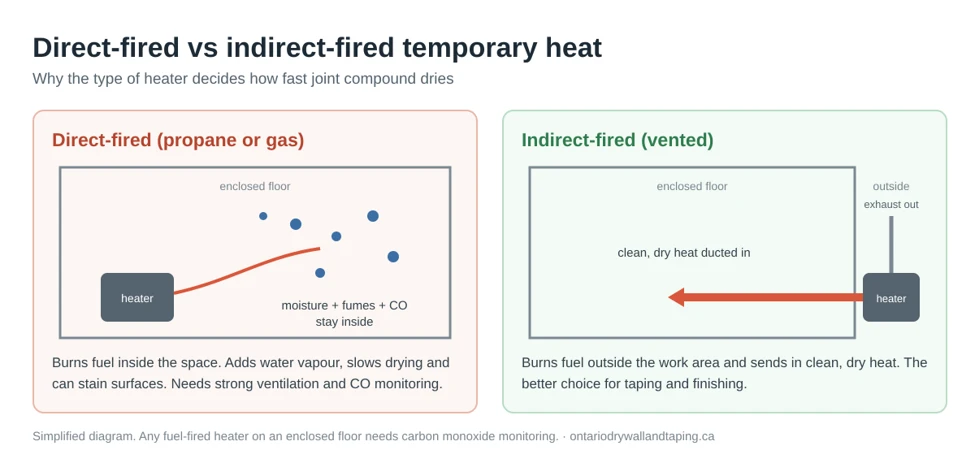
If you have a choice, an indirect-fired heater is the better option for finishing. It burns fuel in a sealed chamber and vents the exhaust outside, so the building gets dry heat without the combustion moisture and fumes. Electric heat works too, where the power supply allows.
The building’s own heating system is often the best heat of all, but running permanent equipment during construction raises questions about filters, dust and warranty. That’s a decision for the GC, owner and mechanical contractor, not the drywall crew.
Whatever you use, safety comes first. Fuel-fired heaters produce carbon monoxide. IHSA, Ontario’s construction safety association, names propane heaters as a common source of carbon monoxide on construction sites and explains the exposure limits and air-testing rules under Ontario’s construction regulation. Enclosed winter floors with fuel-fired heaters running need CO monitoring, every time.
Protect the materials, not just the room
Cold damage often starts before a single joint is taped.
- Store compound in a heated area. Keep it off cold concrete slabs and away from doors. Pails left in an unheated trailer overnight are a common source of frozen compound.
- Never use frozen compound for the finish coat. If it has frozen, check with the manufacturer, and keep it out of the final coats.
- Keep the board dry and let it acclimatize. Gypsum board stored in a cold, damp space picks up moisture. GA-216 requires boards to be protected from weather and condensation, and the board should be completely dry before taping starts.
Setting-type compound helps, but it doesn’t fix everything
Setting-type compound (the powder you mix with water) hardens by chemical reaction rather than by drying alone. That makes it much more forgiving in winter, and it’s what we use for bedding coats and for any fibreglass mesh tape. CGC’s own data sheet says mesh tape must be bedded in setting-type compound.
But setting compound still contains water, and the coats on top of it are usually ready-mix. The room still has to meet the temperature and ventilation minimums. Setting compound buys time. It doesn’t replace heat.
What a winter schedule should look like
The honest answer is that winter finishing takes longer, and a schedule that ignores that is a schedule that will slip anyway, just later and at someone else’s expense.
Plan for:
- Heat on at least 48 hours before taping starts, and kept on until the last coat is dry.
- Longer gaps between coats. In a cold, humid space, a coat that would dry overnight in June can take two or three days.
- Building enclosure first. Taping a floor with open window openings or an unsealed roof is fighting the weather with a propane heater.
- A final check before paint. Joints should be fully dry and cured before primer goes on. Painting over damp compound can trap the moisture and bring the problems back later.
Who is responsible for heat? Settle it at bid time
On many commercial projects, temporary heat sits in the general requirements of the contract and is supplied by the GC. On others it’s left vague, and that’s where disputes start.
Before work begins, the contract or scope letter should spell out:
- Who supplies and pays for temporary heat and fuel
- Who supplies ventilation and carbon monoxide monitoring
- The minimum temperature to be held, and for how long
- Who keeps the heat log
- What happens to the schedule if conditions aren’t met
A drywall contractor who raises these questions at bid time isn’t being difficult. They’re protecting your finish, your schedule and your deficiency list.
Winter taping checklist for GCs and PMs
- Building enclosed, or the work area fully tarped and sealed
- Heat on at least 48 hours before taping
- At least 10°C at the wall surface, or the manufacturer’s higher minimum
- No room above 35°C
- Ventilation running, with no standing humidity
- Carbon monoxide monitoring in place wherever fuel-fired heaters run
- Compound stored warm and never frozen for finish coats
- Heat kept on overnight and on weekends until the compound is dry
- Responsibility for heat, fuel and monitoring written into the contract
Frequently asked questions
What is the minimum temperature for taping drywall?
Industry standard GA-216 calls for at least 10°C (50°F), held from 48 hours before taping until the compound is fully dry. Some manufacturers ask for more. CGC calls for at least 13°C (55°F) for its all-purpose ready-mix compound in Canada.
Can you tape drywall with propane heaters running?
Yes, with care. Direct-fired propane heaters add a lot of moisture to the air, so ventilation is essential, and carbon monoxide must be monitored. Indirect-fired heaters, which vent outside, are the better choice for finishing.
How long does joint compound take to dry in winter?
It depends on temperature, humidity and airflow. A coat that dries overnight in summer can take two or three days in a cold, humid building. If the compound feels cooler than the board around it, it isn’t dry.
Is setting-type compound better in cold weather?
It’s more forgiving because it hardens by chemical reaction, which is why it’s used for bedding coats and mesh tape. But the room still has to meet minimum temperature and ventilation requirements.
Planning a winter project in the GTA?
Ontario Drywall and Taping frames, boards and finishes drywall on commercial projects across Toronto, Vaughan, Mississauga, Brampton, Markham and the rest of the GTA, all year round. We plan winter jobs around heat, humidity and drying time from the start, so the walls still look right after the paint goes on. Send us your drawings or bid invitation, call 647-878-4466, or request a quote online.

